Most silicone molds sold for crafts are made for resin. Resin is pourable, self-levelling, and it does not care whether the mold walls are 2 mm or 6 mm thick. Gypsum is heavier, it sets instead of curing, and it has no flexibility of its own — which is why the same mold that releases a resin coaster perfectly can tear the rim off a gypsum one.
This guide is about picking a mold that survives gypsum, in the shape you actually want to cast.
What makes a mold gypsum-safe
- Wall thickness of 3 mm or more. Thin resin molds bulge under the weight of a gypsum slurry; the piece comes out with a wavy edge and the mold slowly deforms.
- Shore hardness around 20–30 A. Softer than that and the mold collapses; harder and you cannot flex a set cast out without cracking it.
- Open top with a straight wall. Gypsum does not shrink away from the mold the way resin does, so the piece has to slide out. Undercuts — lips, necks, inward curves — lock a rigid cast in place.
- No painted interior. Release coatings wear off into the surface of the cast.
The three mold types, and what each is for
| Type | How it works | Best for |
|---|---|---|
| Open pour | Single cavity, open top, straight walls | Trays, coasters, dishes — anything with one flat face |
| Two-part | Split mould, registered halves, held by a sleeve or bands | Bowls, jars, pieces with a belly or a rounded base |
| Insert / holder | Cavity plus a removable core | Coaster holders, candle cups, hollow forms |
If a piece has any inward curve, it needs a two-part mould. Trying to demould a belly from a one-piece cavity is how most first-time casts break.
Matching the mold to the piece
- Coasters and small trays — shallow open pour, 8–12 mm wall. Fast to fill, fast to demould, and the flat face takes sanding best.
- Serving trays and valet dishes — deeper open pour with a defined rim. Look for 15 mm or more of wall so the rim survives demoulding.
- Bowls and catch-alls — two-part with a rounded base. The registration matters more than the shape: a misaligned split leaves a visible seam that no amount of sanding hides.
- Jars and vessels — two-part plus a core, or a mould with a slight taper. Straight-sided deep jars are the hardest gypsum piece to release.
- Ornaments and small objects — soft, thin-wall moulds are acceptable here because the piece is small and flexes less mass.
What actually kills a silicone mold
- Heat. Exotherm from a large batch, or washing in hot water. Silicone tolerates 200 °C, but repeated warm cycles dull the surface and shorten life.
- Over-flexing. Peeling a mould inside out to pop a cast is the fastest way to split a corner. Flex the walls, not the base.
- Sharp aggregate. Crushed glass and stone grind the cavity surface. Rinse the mould, do not scrub it.
- Leftover residue. Gypsum dust left in the corners sets into a hard skin that prints onto every following cast.
- UV and dust storage. Store closed, dry, and out of sunlight; talc a light dusting if the mould sticks to itself.
Do you need a release agent?
For silicone and gypsum, usually not — silicone releases gypsum cleanly on its own. A release agent becomes useful in three cases: a very deep cavity, a textured surface, or a mould that has started to grab after dozens of casts. When you do use one, use a thin silicone-free or water-based release, not oil: oil stains the cast and blocks the sealer later.
How many casts a mold gives
A well-treated 3 mm silicone mould runs 30–50 casts before the surface dulls; a thin resin mould may fail in ten. The variable is not the brand, it is whether you flex it correctly and rinse it clean after every pour.
Frequently asked
Can I use a resin mold for gypsum?
Sometimes. If it has straight walls, 3 mm or more of thickness, and no undercuts, it will work. Thin, floppy resin moulds deform under the slurry weight and tear the cast on release.
Why does my cast break at the rim?
Three causes: demoulding too early, a mold with an inward lip, or flexing the mould while the rim is still soft. Wait 45–60 minutes, then flex the walls away from the cast before lifting.
How do I clean a mold between casts?
Rinse under lukewarm water and wipe with a soft cloth. Never scrape with a tool, never use hot water, and let it dry fully open-side-up before storing.
Choosing one
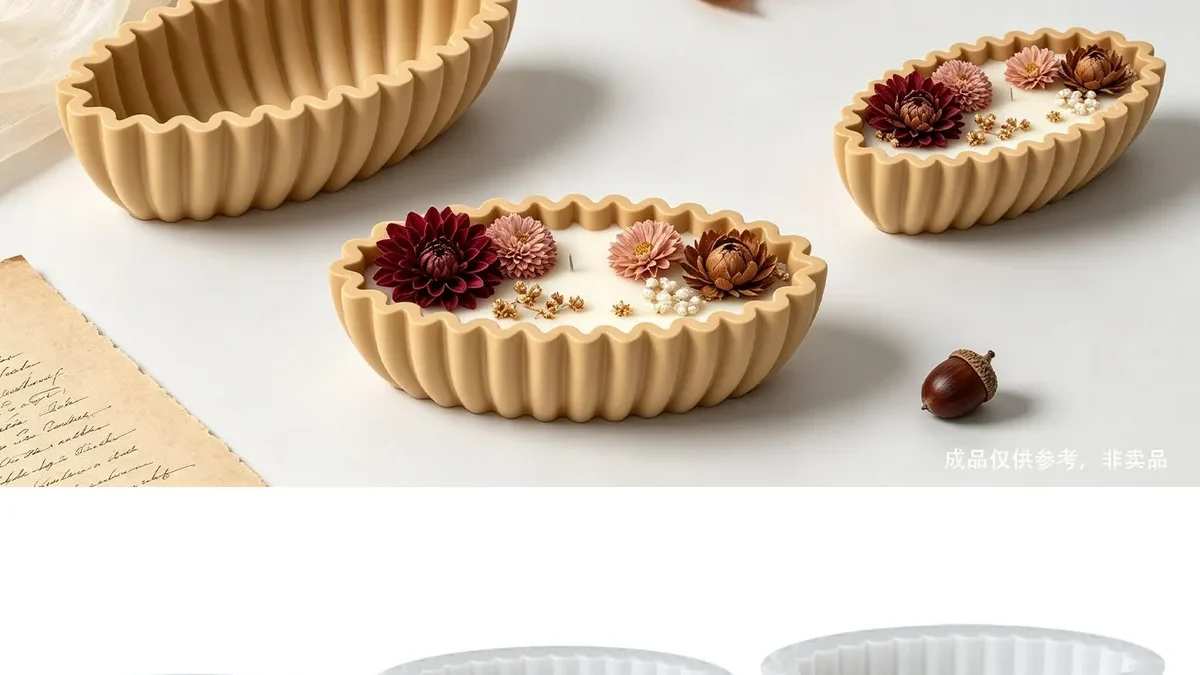
The wavy bowl mold is the two-part case done properly: three sizes, rounded base, clean release. For flat work, the cloud tray mold and the leaf dish mold are open-pour cavities with enough wall to hold their shape. If you want a set rather than one shape, the coaster holder moulds cover the holder-and-insert case, and the ribbed bauble jar mold is the deep-cavity test of your release technique. The silicone mould system page covers care and storage, and the first-cast tutorial walks a pour from mixing to demould.