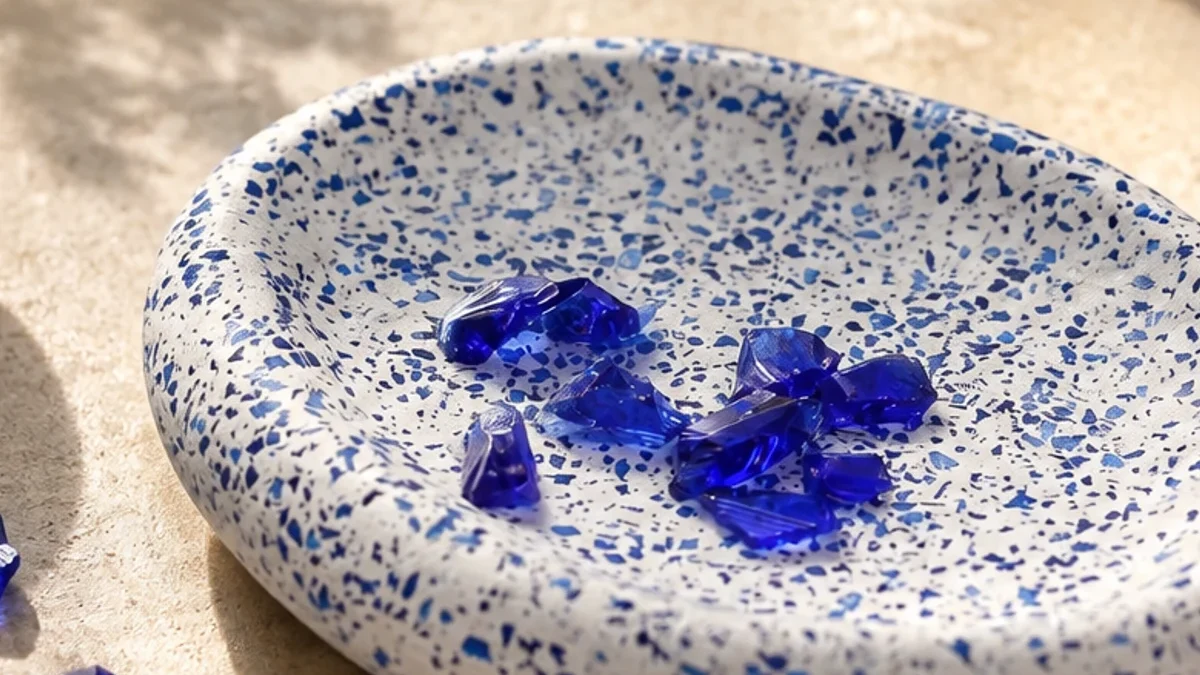
Crushed glass in a gypsum cast looks effortless when it works — light catches the chips, the surface reads like terrazzo, and nothing moves. When it fails, it fails visibly: chips lift at the edges, pockets of glass sit in a crater, or a whole section flakes out after sanding.
The difference is rarely the glass. It is whether the chips were wetted before the pour, in what order the layers went in, and how long you waited before demoulding.
Why glass behaves differently from aggregate
Crushed stone is porous and roughly the same density as the slurry. Glass is neither. It absorbs nothing, it is denser than gypsum, and its edges are sharp at the microscopic level.
Those three facts drive every rule below. Dry glass pulls water out of the slurry on contact, which starves the interface and leaves a weak, dusty bond. Dense chips sink if the slurry is thin. Sharp edges give water a path to sit, and trapped water under a chip is what eventually lifts it.
Three ways to place glass
- Surface-set — pour a base, place chips on the wet surface, backfill just enough to encapsulate. The glass stays near the face, so it reads bright and catches light. Most coasters and small trays are made this way.
- Through-cast — mix chips into the whole batch and pour. The colour is consistent through the thickness and sanding never exposes a plain layer, but you use two to three times more glass.
- Terrazzo — pour a plain base, scatter chips at two or three depths as it firms, then sand back until the chips are flush. This is how the rose tray gets its speckled field: the pattern is revealed by sanding, not by placement.
Ratios that hold
Measure glass against the dry gypsum weight, not the water.
| Style | Glass / dry gypsum | What it gives you |
|---|---|---|
| Speckle | 10–15% | Sparse terrazzo flecks; strong matrix |
| Balanced | 20–25% | Clear glass presence, still sands flat |
| Dense | 30–35% | Glass-forward surface; slower set |
| Above 40% | — | Matrix starves; edges crumble |
Past roughly a third of the dry weight the gypsum stops being the continuous phase — the chips touch each other and the piece loses strength exactly where you want it. If you want more glass than that, make the piece thinner rather than denser.
The method, in order
- Wet the glass first. Rinse the chips in a sieve under running water and shake off the excess. Damp chips stop stealing water from the slurry. This single step prevents most edge lifting.
- Mix the base slurry normally. Standard water-to-gypsum ratio, no extra water to "help it flow" — thin slurry lets dense chips sink away from the face.
- Pour the base, then place. Fill about two thirds of the mould, then place chips by hand where you want them. Dumping them in gives clumps and a patchy face.
- Backfill slowly. Spoon slurry over the chips rather than pouring — a direct pour displaces them. Tap the mould firmly against the bench a dozen times to walk air out.
- Wait longer than usual. Glass edges cut into a cast that is still soft. Leave 45–60 minutes before demoulding, and handle the piece by the edges for the first day.
- Sand wet. 120 grit to flatten, 240 to remove scratches, 400 to bring up the glass. Wet sanding only — dry sanding releases respirable silica, which is a real hazard, not a convenience issue.
- Seal after sanding. Sanding opens the pores you had closed, so the sealer goes on last, once the piece is bone dry.
Why chips come loose
- Dry glass. The interface is starved and dusty; the chip sits in a pocket rather than being gripped.
- Too much water. A wet mix shrinks more as it cures, and glass does not shrink with it — the gap opens at the rim.
- Demoulded early. Soft gypsum tears around a sharp edge; you will not see it until you sand.
- Sanded through. Sanding past the encapsulation line exposes the chip's underside and it lifts on the next pass.
- Not sealed. Water gets in along the glass-gypsum boundary, freezes or crystallises, and works the chip loose over a season.
Which glass to use
Tumbled or fire-polished chips are the safe default: no sharp edges, consistent size, predictable colour. Flat glass and tempered offcuts work if you crush and tumble them first. Avoid mirrored glass with backing film, and avoid unknown glass from windows or car glass — the coatings and laminates do not bond and can leave haziness under the surface.
Frequently asked
How much crushed glass per 100 g of gypsum?
Between 10 and 35 g depending on the look, and never above about 40 g. Weigh the dry gypsum, not the mixed slurry.
Can I use glass straight from the bag?
Rinse it. Bagged chips carry dust and static that repel the slurry; a quick wash and shake is the difference between a bonded chip and a loose one.
Do I have to seal a glass cast?
Yes, and more than a plain cast. Sanding leaves the glass edges slightly proud and the gypsum around them open, so water finds the boundary first. The sealing guide covers the sequence.
Making one
The coaster kit is the shortest route to the surface-set method — four pieces, one pour. For a light-catching object, the tealight holder kit uses the same ratio in a thicker wall. The terrazzo approach is what the rose terrazzo tray is built around, and the crushed glass system page shows where glass sits in the build order. Finish with the sealing method.